
Paintless dent repair, or PDR, sounds almost too good to be true: a dent disappears and the paint is never touched. For the right dent it really does work that way. For the wrong one it cannot, and knowing the difference saves time and disappointment. This guide explains what is going on in the metal, how the work is done, and how to tell whether your dent is a good candidate. It is written for drivers in New York City, Westchester and Long Island, where door dings come free with street parking.
What a dent does to the metal
A car panel is a thin sheet of steel or aluminum pressed into shape at the factory. When something hits it, the metal bends inward. If the hit is soft and rounded, like a door edge or a hailstone, the metal mostly bends without stretching. It still has roughly the same surface area it had before, just pushed out of place. That kind of dent can be worked back.
If the hit is sharp or hard, the metal stretches. A crease, a tear or a dent with a sharp line in the middle means some of the metal is now longer than it was. Stretched metal has nowhere to go when it is pushed back, so it bulges or oil cans instead of sitting flat. That is the first limit of PDR.
The second limit is the paint. Factory paint is flexible enough to move with the metal a little. If the paint has already cracked or chipped in the dent, it cannot survive more movement, and the spot will need paint anyway.
Reading a dent with light
You cannot fix what you cannot see, and many dents are nearly invisible in flat light. PDR technicians read a panel with a reflection: a light board, a lined panel or a lamp set so its lines or edges reflect in the paint. A flat panel shows straight, even lines. A dent bends them inward. A high spot bends them outward.
Watching that reflection while working is the heart of the craft. Each small push from behind shows up as a change in the reflected lines, and the technician works until the lines run straight again. It is slow, careful work, and it is why a good PDR repair can be hard to find afterwards even in bright sun.
The tools of the trade
PDR uses a small set of simple tools, chosen for each dent:
- Rods. Long steel rods with shaped tips, slipped behind the panel through existing openings to push the metal up from inside in many small moves.
- Glue tabs and pullers. Where there is no way in from behind, such as a roof rail or a double skinned area, a tab is glued to the outside of the dent and pulled. The glue releases cleanly and does not harm factory paint.
- Knockdowns. Plastic or nylon tipped tools tapped lightly to bring down high spots and crowns that form around a dent.
- Lights and boards. The reflection that guides every move.
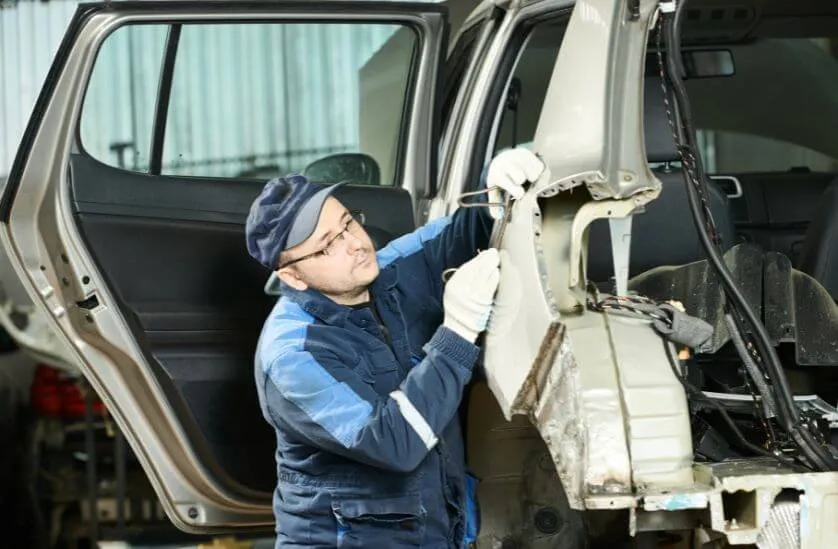
Access is the practical part. Technicians reach in through gaps such as window openings, drain holes and trim mounts, and sometimes remove a tail light, an inner fender liner or the headliner to get to the back of a panel.
Which dents suit PDR
Most dents that come out well have these things in common:
- The paint is whole. No cracks, chips or flaking.
- The dent is soft and round, not a sharp crease or a line.
- It is away from the edge of the panel, where metal is folded double and hard to move.
- The back of the panel can be reached, or the outside can take a glue tab.
- The panel has no earlier filler, which can crack when the metal moves.
Size alone is not the deciding factor. A wide, shallow dent on a door can be easier than a small sharp one on a body line. Aluminum panels can often be done but are stiffer and less forgiving than steel. So, does paintless dent removal really work? On the right dent, very well. That page goes into where it shines and where it does not.
Questions worth asking before PDR
A good technician answers these before any work starts. The answers tell you what to expect.
Will it come out fully?
On a fresh, soft dent the honest answer may be yes. On a deep or old one it may be a big improvement rather than perfect.
What has to come off?
Lights, liners or a headliner may need removing for access. Ask what and why.
Is the paint at risk?
If there is a chance the paint could crack, you should hear it now, not after.
Has this panel been repaired before?
Old filler under the paint changes the plan. A paint thickness check can find it.
What if PDR is not enough?
Ask what the fallback is: a small touch of conventional repair, or filler and paint.
Does insurance come into it?
If the dent came from something your policy covers, ask how the claim would work.
Common dents and how they behave
Different kinds of damage leave different kinds of dent, and some are far friendlier to PDR than others.
- Door dings. The edge of another car door leaves a small, round dent, usually mid door. These are classic PDR work, as long as the paint is not chipped where the edge hit.
- Shopping cart and knee bumps. Low, wide and shallow. Usually good candidates, though dents low on a door can sit over a brace.
- Hail. Dozens of small, round dents on the upward facing panels. Ideal for PDR in most cases, which is why it is the main method after a storm.
- Things that fell or were leaned on. Snow and ice sliding off a roof, a ball, someone sitting on the hood. Often soft and repairable, depending on depth.
- Creases. A long line pressed in by a bike, a post or a scrape along the side. The metal is often stretched, so these are harder and may need conventional repair.
- Bumpers. Most modern bumpers are plastic covers, not metal. Small pushed in areas can sometimes be reshaped with heat, but that is a different job from PDR.
When PDR is the wrong tool
A good shop will say no to PDR when it will not give a good result. The usual reasons are cracked or chipped paint, a sharp crease, a dent on the very edge of a panel, metal that has stretched, or old filler underneath. Damage from a real collision is also a different job: a hit hard enough to fold a panel may have pushed brackets, sensors or structure behind it, and that needs a full look over.
Sometimes the answer is a mix. PDR takes most of the dent out, and a small conventional repair finishes a spot where the paint was broken. That still saves most of the original finish.
Weather, cold and timing
Paint and metal are both less forgiving in the cold. A dent worked on a freezing panel is more likely to crack the paint, which is why PDR is best done indoors in a warm space rather than on a street corner in January. Fresh dents also tend to come out more easily than ones that have sat for years, though old dents can still often be improved a great deal.
What PDR means for cost, value and claims
Because the paint stays put, PDR usually means less material and less labor than a conventional repair, and the car keeps its original finish. That matters at lease return, when a car is inspected for dents, and when selling, because a repainted panel can be picked up with a paint gauge. What sets the price of a particular job, from the number of dents to access and metal type, is explained in how much paintless dent repair usually costs.
Insurance does not care much about the method. If the dent came from something your policy covers, such as hail under comprehensive or a covered collision, PDR is just the repair. Small parking lot dings often cost less than the deductible, which is why many people pay for them directly. Will insurance pay for PDR covers which coverage applies and when a claim makes sense. Our insurance claims page explains how claims work with the shop.
Judging the finished repair
When the car is ready, look at the repaired spot the way the technician did: at an angle, toward a light or a bright sky, so the reflection runs across where the dent was. The lines should run straight and even. Look from more than one side. A good repair leaves no low spot, no ripple and no raised ring. If the plan was a big improvement rather than perfection, judge it against that, and ask about anything you are not sure of before you drive off.
One question,one straight answer.
Each of these has its own page with a short answer up top and the detail underneath.
Having a dent looked at
The quickest way to know whether your dent is a PDR candidate is to have someone read it under a light. Our paintless dent repair page covers how we handle it: an honest look and a free estimate before any work starts, and we work with your insurance company and handle the claim if there is one. The shop is at 99-49 66th Ave in Forest Hills, Queens, and it is open 24 hours. Call or send us the details.
Not sure if PDR will work? Call us.
646-347-5520Open 24 hours.
Get a Free Estimate