
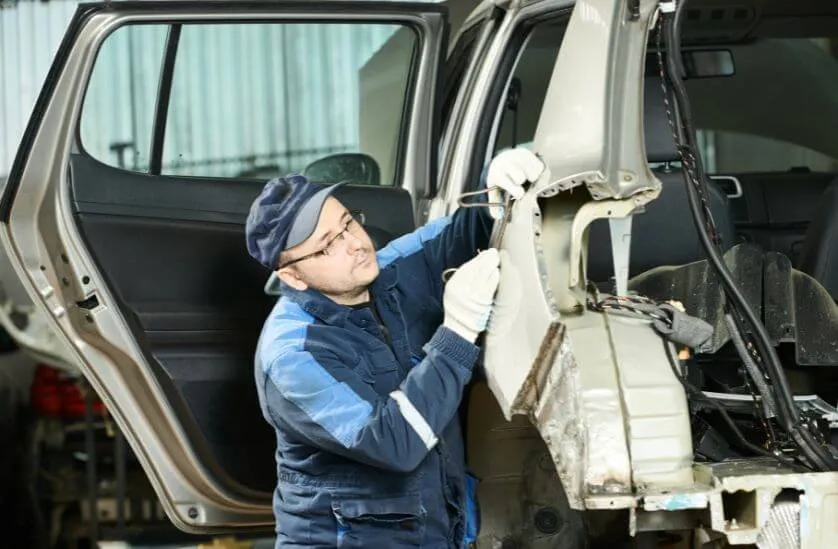
What frame repair covers
The frame is the skeleton of a car. On a truck or a big SUV it is a separate steel ladder under the body. On most cars and crossovers it is a unibody: the floor, pillars, rails and roof welded into one shell. Either way, it holds the suspension, the engine and the doors in the right place, and it is built to fold in a crash in a set order to protect the people inside.
When a hit is hard enough to move that structure, the car stops being square. The wheels no longer point the same way, the doors no longer meet their openings, and the crumple zones that already did their job will not do it again. Frame repair is the work of measuring that movement and putting the structure back where the car maker designed it to be.
Frame repair usually involves some of these:
- Measuring. The structure is checked at set points and compared with the car maker's dimensions.
- Straightening. The frame or unibody is anchored and pulled back into place in controlled steps.
- Sectioning and replacing. Rails, supports or crumple zones that are kinked past saving are cut out and replaced where the car maker allows it.
- Suspension and alignment. Mounting points are checked so the wheels sit and track straight once the structure is right.
- Panels and paint. Once the skeleton is straight, the outside panels are fitted, aligned and refinished.
Signs the hit reached the frame
Frame damage hides well. These are the clues that something under the panels has moved.
Panel gaps that do not match
Compare the gap between the hood and fenders, or the doors and pillars, side to side. A wider gap on one side is a classic sign.
Doors, hood or trunk that will not close right
If an opening has shifted, the panel that fits it will bind, sit proud or need slamming to latch.
The car pulls or crabs down the road
A bent rail or a moved suspension mount can make the rear wheels follow a slightly different line from the front.
Uneven tire wear
One tire wearing on its inside or outside edge soon after a crash points to geometry that is out.
New creaks, clunks or rattles
Noises over bumps that were not there before can come from parts no longer sitting where they should.
The car sits lower on one corner
Park on flat ground and look at it from the front and back. A corner that sits differently is worth a check.
Why the panels can look straight when the frame is not
Modern cars are designed to absorb crash energy out of sight. The bumper cover flexes back, the outer panels may only crease, and the force goes into the rails and supports behind them. That is good for the people inside, and it is also why a car can roll away from a crash looking almost fine with its structure pushed out of place.
This is the most common reason a first estimate grows. The structure cannot be measured properly until the car is on the bench and parts are off. When frame damage turns up, it is documented, photographed and sent to the insurer for approval before the work goes further. When we handle your claim, that back and forth is ours to deal with.
How a frame repair runs
Structural work follows a careful order. The measuring comes before the pulling, and the pulling comes before anything cosmetic.
Look over
The car is checked for the signs of structural damage, inside, outside and underneath.
Measure
Set points on the frame or unibody are measured and compared with the car maker's dimensions.
Estimate
You get a free estimate before any work starts, showing what moved and what it takes to fix.
Claim
We work with your insurance company and handle the claim, including damage found once parts come off.
Straighten
The structure is pulled back into line, damaged sections are replaced, and the measurements are checked again.
Pickup
Panels, alignment and paint are finished, and you get your keys back.
Straighten or replace: who decides
Not every bent rail can be pulled back. Steel that has kinked sharply, cracked, or been heated in the wrong way may be weakened even if it looks straight afterward. Car makers publish repair rules for their structures, including which parts can be straightened, which must be replaced, and where a section can be cut and joined. A good frame repair follows those rules rather than guessing.
That matters for more than safety. The structure carries the suspension, so a car that is not back to its dimensions will wear tires, pull, and never feel right. Many newer cars also have cameras and radar sensors mounted to the body, and those need the structure in the right place to aim properly.
Frame damage is often found late. We take it to the insurer for you.
Structural damage usually shows up once the car is opened up, after the first estimate. We document it, send it to your insurance company and handle the claim, so the repair is not left half done.
Free estimate first
You know what is being fixed before any work starts.
Extra damage handled
We work with your insurance company on anything found once the car is opened up.
Your choice of shop
You can pick your own shop, whatever the insurance list says.
Frame work rarely comes alone.One shop, one claim.
A hit hard enough to bend the structure usually damages panels, glass and paint too. These repairs often go with frame work.
Frame repair across New York City
We take frame work from all five boroughs, Westchester and Long Island. The shop is in Forest Hills, so for Queens drivers it is close by. Frame repair is usually one part of a wider collision repair, and our insurance claims page explains how the claim gets paid. To get the car checked, call or send us the details, and read what other drivers have said on our reviews page.
Frame damage usually travels with other repairs. A hit that bends the structure can also crack the windshield, which is a job for auto glass repair, and rusted rails on an older car are often an auto body restoration job. Once the structure is straight, car painting and refinishing puts the finish back. Drivers from the Bronx and the other boroughs use the same shop.
Read up first.Then call.
Plain answers to the questions drivers ask before and after a repair: what it involves, who pays, and what to check.
Frame repair questions
How do I know if my frame is bent?
You often cannot tell by looking. Common signs are uneven gaps between panels, doors or a trunk that will not close properly, a car that pulls or tracks crooked, tires wearing on one edge, and new creaks over bumps. The only sure answer is to have the structure measured.
Can a bent frame be fixed, or is the car totaled?
Many bent frames and unibodies can be pulled back to the car maker's measurements. Whether a car is repaired or written off is a call the insurer makes by comparing the repair cost with the car's value. Get a free estimate first so you know what the damage really is.
Is it safe to drive with frame damage?
It is not a good idea. The frame or unibody holds the suspension in place and is built to absorb a crash in a set way. If it has moved, the car may handle oddly and protect you less in the next hit. Call 646-347-5520 before you put more miles on it.
Does insurance cover frame repair?
If the damage came from a crash, frame repair is normally part of the collision claim. Frame damage is often found after the estimate, once panels come off, and is sent to the insurer as extra damage for approval. We work with your insurance company and handle that for you. See our insurance claims page.
What is the difference between a frame and a unibody?
Trucks and some large SUVs have a separate steel frame with the body bolted on top. Most cars and crossovers have a unibody, where the body and frame are one welded shell. Both can be bent in a crash, and both are measured and straightened in a similar way.
Will frame damage show on a vehicle history report?
It can, depending on whether the crash was reported and how the insurer recorded it. A proper repair back to the car maker's measurements matters more than the report, because it decides how the car drives and how it protects you.
Car pulling after a crash? Call now.
646-347-5520Open 24 hours.
Get a Free Estimate